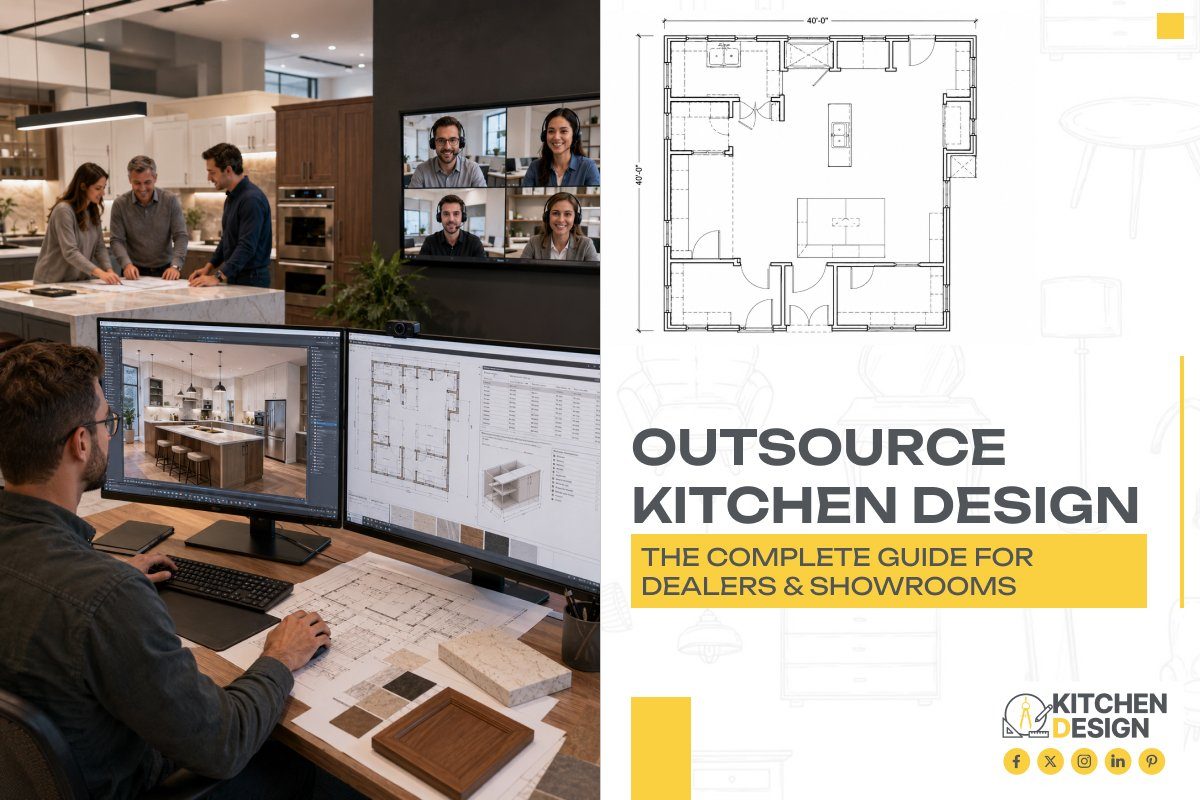
Outsourced kitchen design is a service where an external team of trained kitchen designers produces your floor plans, 3D renderings, cabinet specifications, and price-ready quotes — on demand and under your brand — using professional software like 2020 Design, ProKitchen, or AutoCAD. Instead of hiring, training, and equipping in-house designers, you send measurements and a brief, and receive a complete design package back in days.
For cabinet dealers, showrooms, remodelers, and manufacturers, that shift solves the most expensive bottleneck in the business: design capacity. This guide explains exactly how to outsource kitchen design, what you get, what it costs, and how to choose the right partner.
Why dealers and showrooms outsource kitchen design
Most kitchen businesses don’t lose deals because of price or product. They lose them because designs take too long. A single in-house designer can usually only push through a handful of full projects per week once revisions pile up — and every hour spent designing for a tire-kicker is an hour not spent designing for a buyer.
Outsourcing turns a fixed cost (salary, software licenses, hardware, training time) into a variable cost that scales with your project flow. When you outsource kitchen design, you can:
- Quote and design more projects per week without adding headcount.
- Shorten your sales cycle by presenting renderings and pricing earlier, often in the first meeting.
- Eliminate the revision bottleneck that quietly erodes margin.
- Scale up and down seasonally without hiring or layoffs.
- Free your best people to sell instead of sitting in front of a screen.
The math is simple: design output drives revenue. The faster a homeowner sees a photorealistic version of their kitchen, the faster they commit.
What’s included in an outsourced kitchen design package
A professional outsourced design package is far more than a pretty picture. A complete deliverable typically includes:
- 2D floor plans and elevations with accurate dimensions
- High-quality 3D renderings of the space
- 360° panorama / virtual reality views for immersive client presentations
- A cabinet specification list mapped to a real manufacturer catalog
- A price list / quote-ready material list so you can build a bid fast
- The native design file (for example a 2020 .KIT file) plus a PDF quote
- Your logo and branding applied across every page
That last point matters: white-labeled packets let your customers see your brand on professional work, even though the production happened off-site.
How the outsourcing process works
The workflow is designed to fit around your sales process, not replace it:
- You send the brief. Measurements, photos, meeting notes, inspiration images, and the cabinet brand you want priced.
- The design team builds it in your chosen software using that brand’s real catalog.
- You receive the full package — typically in [X-day turnaround] — branded and ready to present.
- You request revisions if needed, which come back within a short, defined window.
- You present, win the job, and order using the spec and KIT file provided.
Because the team works in the same catalog-driven software your manufacturers use, the output is production-accurate — not a generic 3D mock-up that falls apart when it’s time to order.
Which software should your design partner use?
The software determines accuracy, catalog access, and how the file moves into ordering. The three most common professional platforms:
- 2020 Design (Cyncly): the industry standard across the U.S. kitchen and bath market, with deep manufacturer catalog integration and .KIT files that flow straight into quoting.
- ProKitchen: popular with dealers and showrooms for catalog-driven cabinet and appliance planning and strong presentation/VR output.
- AutoCAD: the choice for custom millwork, manufacturers, and detailed production drawings where precision is paramount.
The right partner can work in whichever platform your business already runs on — so you’re not forced to change tools. (See our dedicated guides on ProKitchen design services and AutoCAD cabinet drafting services.)
How much does it cost to outsource kitchen design?
Pricing is usually per project rather than per hour, which makes it predictable. Industry benchmarks for outsourced renderings commonly run a few hundred to a couple thousand dollars per project depending on complexity, rendering quality, and revision count. Many specialized B2B design services — including ours — start far lower, with packages from [starting price] and postpaid, flexible pricing for volume clients.
Compare that to the true cost of doing it in-house: software licenses (often $3,500+ before catalog renewals), a graphics-capable workstation, months of training, and a full-time salary — all of which you pay before you see a single closed deal. Outsourcing produces return before investment, not after. For a full breakdown, see our cost to outsource kitchen design guide.
How to choose a kitchen design outsourcing partner
Not all providers are equal. Evaluate on:
- Software fit — can they work in 2020, ProKitchen, and AutoCAD?
- Catalog breadth — do they know your cabinet brands and SKUs?
- Turnaround and revision policy — how fast, and how many rounds are included?
- Branding — will the deliverables carry your logo?
- Quality control — who reviews designs before they reach your client?
- Deliverables — do you get the editable native file, not just images?
A partner who checks all six becomes an extension of your team rather than a vendor you have to manage.
Who outsources kitchen design
Outsourced design isn’t only for shops without a designer. Different business types use it differently:
- Cabinet dealers clear design backlogs and present faster than local competitors. See our kitchen design services for cabinet dealers.
- Kitchen & bath showrooms outsource overflow and revisions so in-house designers can focus on selling on the floor.
- Remodelers and contractors turn a site visit into a visual proposal within days, not weeks.
- Cabinet manufacturers and online retailers scale catalog-based design and quoting across high volumes.
- Buying groups and rep groups offer it as a shared design resource so their members quote more without staffing up.
The common thread: design is the moment a prospect emotionally commits — so whoever delivers it fastest tends to win the job.
Common concerns about outsourcing — answered
Three objections come up again and again:
- “Will quality match my in-house work?” It will be when the partner runs a quality-control step and learns your house style through a short trial project. Designs are built in the same catalog-driven software your manufacturers use, so specs are production-accurate.
- “Will my customers know it’s outsourced?” No. White-label delivery puts your logo on every plan, rendering, and quote, so the experience is seamless under your brand.
- “Is my data and catalog safe?” A professional partner works only from the brief you provide, designs in the brands you specify, and returns editable files you own.
Clear these three, and the only question left is how much faster you want to grow.
Conclusion
Outsourcing kitchen design is no longer a workaround for shops that can’t afford a designer — it’s a deliberate growth strategy. It converts design from a capacity ceiling into an on-demand engine, letting dealers and showrooms quote faster, present better, and close more without payroll risk. Whether you run on 2020 Design, ProKitchen, or AutoCAD, the goal is the same: more qualified designs out the door, more deals won.
Ready to scale your design output? Start a design trial today
FAQ
Outsourcing kitchen design means hiring an external team to produce your floor plans, 3D renderings, cabinet specs, and quotes using professional software, delivered under your brand. You send measurements and a brief; you receive a complete, client-ready design package without employing an in-house designer.
Most outsourced kitchen design is priced per project rather than hourly, commonly ranging from a few hundred to a couple thousand dollars depending on complexity and rendering quality. Specialized B2B services often start much lower, making per-project pricing far more predictable than the cost of in-house staff and software.
The three industry-standard platforms are 2020 Design (Cyncly), ProKitchen, and AutoCAD. 2020 Design is the most widely used for catalog-driven kitchen and bath work, ProKitchen is popular for dealer presentations, and AutoCAD handles custom millwork and production drawings.
Yes, when the partner uses catalog-accurate software and applies quality control. Because designs are built in the same professional tools your manufacturers use, the output is production-ready — accurate specs, real SKUs, and photorealistic renderings — not generic mock-ups.
Yes. White-label kitchen design services apply your logo and branding to every floor plan, rendering, and quote, so customers see your brand on professional work even though production happens off-site.
Turnaround varies by provider and complexity, but a full initial package commonly comes back within a few business days, with revisions returned in a short, defined window. Fast turnaround is one of the main reasons dealers outsource.